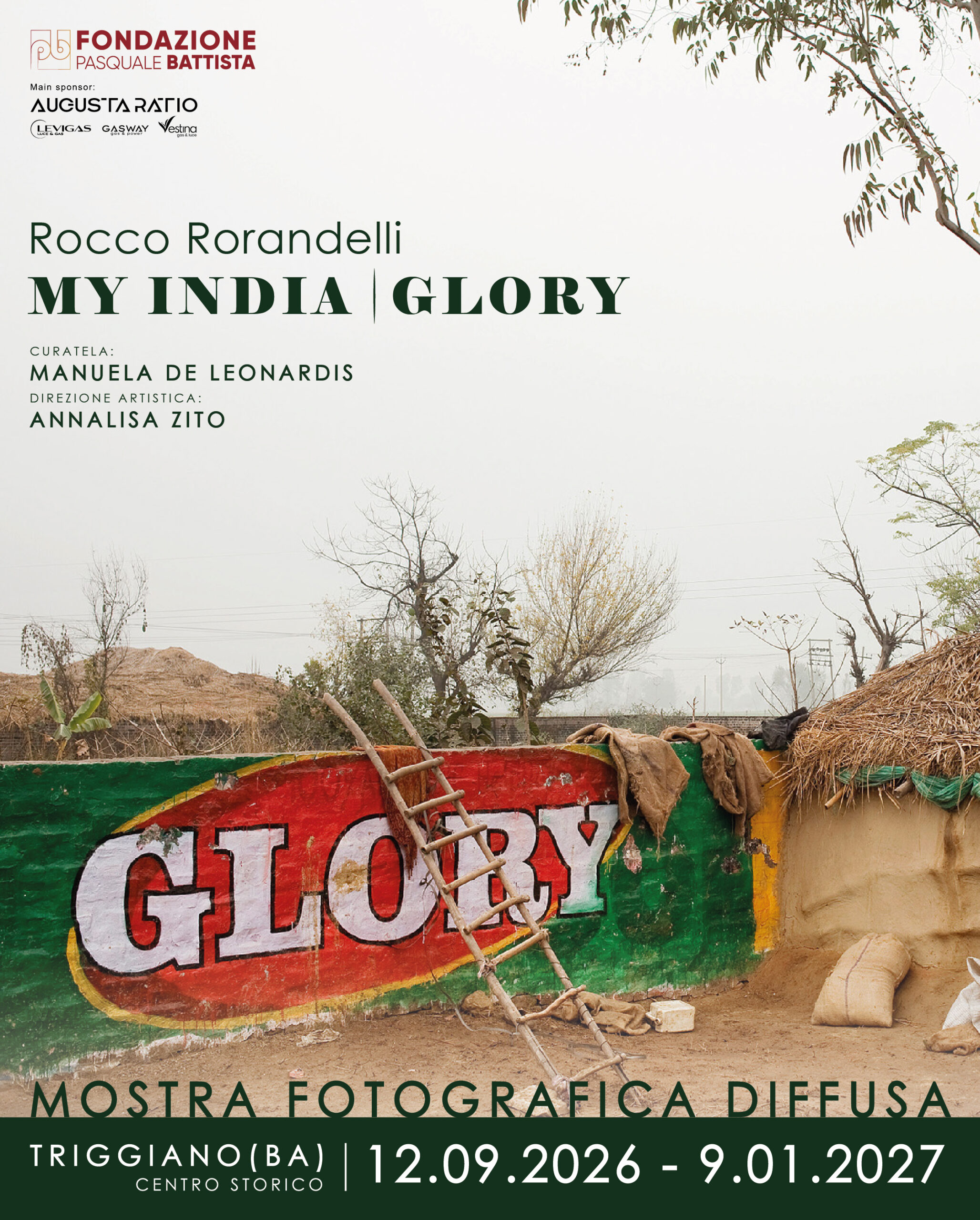
Rocco Rorandelli
My India / Glory

MOSTRA
INGRESSO LIBERO
Info per visita guidata gratuita al 3532144485
INGRESSO LIBERO
Per info e prenotazione visita gratuita: 3420771754
Manuela De Leonardis (curatrice della mostra)
C’è una relazione tra i sogni di gloria e il cemento? «Glory», «concrete dreams», «confidence building». Parole che esprimono desideri proiettati in un futuro potenzialmente distopico, quelle che affiorano nel corto circuito visivo colto da Rocco Rorandelli attraverso le sue fotografie della serie My India. Un progetto iniziato nel 2008, attualmente in corso, nato come «diario personale» dei viaggi in India del fotografo membro fondatore del collettivo TerraProject con Michele Borzoni, Simone Donati e Pietro Paolini. Si tratta del racconto dei cambiamenti radicali del paesaggio umano, naturale e urbano soprattutto di tre grandi città del subcontinente indiano: Delhi, megalopoli del nord; Mumbai, megalopoli del Sud e Chandigarh, capitale di due stati – Punjab e Haryana – che lega il suo nome al progetto utopico di Le Corbusier. Tra stupore e sgomento, queste immagini a colori suscitano emozioni contraddittorie e in parte ambigue di un’India lontana da qualsivoglia suggestione esotica, sempre più vicina – semmai – alle periferie urbane che popolano il globo terrestre, sia ad est che a ovest. In questa decostruzione di un’immagine da cartolina che inquadra edifici e persone, il senso di iniziale spaesamento provato dall’osservatore si trasforma, piuttosto, in uno sguardo che senza essere indulgente è quasi assuefatto alla familiarità che riconosce in quei «non luoghi». Un paradosso colto da Rorandelli nel soffermandosi, in particolare, sui diversi aspetti della cementificazione progressiva degli spazi urbani che avanza accerchiando, inglobando e arrivando a cancellare – parzialmente o totalmente – la natura addomesticata. Questo fenomeno di trasformazione delle aree periferiche riguarda, oltre che l’economia e l’ambiente, anche il movimento delle persone: la massiccia migrazione dalle campagne verso le città e il conseguente abbandono e «desertificazione» di altri luoghi. L’India con la sua forza militare (dal 1974 possiede la bomba atomica), leader mondiale nell’industria tecnologica e nell’outsourcing, ma anche il paese più popoloso della terra con oltre 1,4 miliardi di abitanti, si trova a fare i conti da una parte con un notevole boom economico, dall’altra con lo stravolgimento di zone rurali e urbane che in questa crescita improvvisa perdono la loro identità. «Il mio interesse è spinto un po’ da questo, cioè dal documentare questa fase espansiva,» – afferma il fotografo – «questo momento in cui le città si allargano, in cui gli spazi vuoti si riempiono, che coinvolge l’aspetto sociale. Ci sono gruppi sociali, ad esempio, che lasciano il posto ad altri e la presenza di costruzioni temporanee, come le tendopoli dei lavoratori stagionali che sorgono nelle periferie delle megalopoli e che, ad un certo punto, scompariranno e lasceranno quegli spazi liberi per la costruzione di altri palazzi.» Il formato quadrato delle fotografie è frutto di una scelta iniziale dell’autore, nell’utilizzo della pellicola impiegata per fotografare con l’Hasselblad. Successivamente, il lavoro è continuato in digitale, mantenendo quest’uniformità stilistica che non esprime soltanto una qualità estetica di rigore simmetrico e ordine visivo, ma anche il rapporto stesso del fotografo con il soggetto, diretto e bilanciato. Nell’inquadrare quella realtà, a Rorandelli non sfuggono i vicoli ciechi, gli edifici abbandonati o non finiti, oltre che gli effetti macroscopici del processo antropogenico del consumo del suolo. «Il percorso è abbastanza univoco, però se vai a osservarlo nella scala più piccola è lì che puoi percepire anche la presenza di errori o di passi indietro, di tentativi che non sono andati a buon fine. Un po’ di questo si trova in tutte le mie fotografie, che alternano architetture ai ritratti o alle foto che raccontano l’umanità che vive in quegli spazi.» Nel valore del linguaggio documentario, si evidenzia l’estrema libertà dell’autore nel suo immergersi in una commedia umana i cui personaggi mantengono la loro integrità: dalla giovane coppia di nuovi ricchi seduti sul divano nel salotto della loro casa borghese alle due ragazze del circo con i fucili-giocattolo, dal venditore di gelati alla squadra di hockey su prato, dall’uomo in attesa accanto ai cartelli pubblicitari ai riflessi sull’acqua del gruppo che cammina. Uomini e donne colti nei loro gesti ordinari, in dialogo con lo scenario di cui fanno parte, in una convivenza quotidiana di accettazione o critica, comunque partecipi di un destino comune.
Manuela De Leonardis
Manuela De Leonardis (exhibition curator)
Is there a connection between dreams of glory and concrete? ‘Glory’, ‘concrete dreams’, ‘confidence building’. Words that express desires projected into a potentially dystopian future – the very ones that emerge in the visual short-circuit captured by Rocco Rorandelli through his photographs in the series *My India*. A project begun in 2008 and still ongoing, it began as a ‘personal diary’ of the photographer’s travels in India; Rorandelli is a founding member of the TerraProject collective alongside Michele Borzoni, Simone Donati and Pietro Paolini. It is an account of the radical changes in the human, natural and urban landscape, particularly in three major cities of the Indian subcontinent: Delhi, the megacity of the north; Mumbai, the megacity of the south; and Chandigarh, the capital of two states – Punjab and Haryana – whose name is linked to Le Corbusier’s utopian project. Oscillating between wonder and dismay, these colour images evoke contradictory and, in part, ambiguous emotions, portraying an India far removed from any notion of exoticism, and increasingly akin – if anything – to the urban peripheries that populate the globe, both East and West. In this deconstruction of a postcard image framing buildings and people, the sense of initial disorientation felt by the observer transforms, rather, into a gaze which, whilst not indulgent, is almost accustomed to the familiarity it recognises in those ‘non-places’. A paradox highlighted by Rorandelli as he focuses, in particular, on the various aspects of the progressive urban sprawl that advances by encircling, engulfing and ultimately erasing – partially or entirely – domesticated nature. This phenomenon of the transformation of peripheral areas affects not only the economy and the environment, but also the movement of people: the massive migration from the countryside to the cities and the consequent abandonment and ‘desertification’ of other places. India, with its military might (it has possessed the atomic bomb since 1974), a world leader in the technology industry and outsourcing, but also the most populous country on earth with over 1.4 billion inhabitants, finds itself grappling, on the one hand, with a remarkable economic boom and, on the other, with the upheaval of rural and urban areas which, in the midst of this sudden growth, are losing their identity. ‘My interest is driven partly by this – that is, by documenting this phase of expansion,’ says the photographer, ‘this moment in which cities are spreading out, in which empty spaces are being filled, and which involves the social aspect.’ ‘There are social groups, for example, that give way to others, and the presence of temporary structures, such as the tent cities of seasonal workers that spring up on the outskirts of megacities and which, at some point, will disappear, leaving those spaces free for the construction of new buildings.’ The square format of the photographs stems from an initial choice made by the artist regarding the film used for shooting with the Hasselblad. Subsequently, the work continued in digital form, maintaining this stylistic uniformity, which expresses not only an aesthetic quality of symmetrical rigour and visual order, but also the photographer’s own relationship with the subject – direct and balanced. In framing that reality, Rorandelli does not overlook the dead-end alleys, the abandoned or unfinished buildings, nor the macroscopic effects of the anthropogenic process of land consumption. ‘The trajectory is fairly straightforward, but if you look at it on a smaller scale, that is where you can also perceive the presence of errors or setbacks, of attempts that did not come to fruition.’ There’s a bit of this in all my photographs, which alternate between architecture and portraits, or images that capture the humanity living within those spaces.’ The value of the documentary style lies in the photographer’s extraordinary freedom as he immerses himself in a human drama whose characters retain their integrity: from the young, newly wealthy couple sitting on the sofa in the living room of their middle-class home to the two circus girls with their toy guns, from the ice-cream seller to the field hockey team, from the man waiting beside the advertising hoardings to the reflections on the water of the group walking by. Men and women captured in their everyday gestures, in dialogue with the setting of which they form part, in a daily coexistence marked by acceptance or criticism, yet in any case sharing a common destiny.
Manuela De Leonardis
STAFF MOSTRA
Direzione artistica
Annalisa zito
Curatela
Manuela De Leonardis
Exhibition Designer
Arch. Dino Lorusso
Project Management
Cinzia Campobasso
Coordinamento tecnico
Ninni Castrovilli e
Lisabeth Ciavarella
Ufficio Stampa
Tommaso Forte
Segreteria organizzativa
Claudia Lopuzzo
Progetto grafico
Stefano Quagliarella
Progetto sito web
Officina Réclame
Allestimento e montaggio opere
We Makers
FONDAZIONE PASQUALE BATTISTA
Presidente
Flavio Augusto Battista
Vicepresidente
Claudio Battista
Consigliere di Amministrazione
Edoardo Fulvio Battista
Direttrice
Annalisa Zito
Project Manager Area Ricerca e Sviluppo
Cinzia Campobasso
Cultural Manager
Rosanna Carabellese
Cultural Project Manager
Luca Carnicelli
Marketing & Communication Manager
Lisa Andriani
un progetto di

in collaborazione con

MAIN SPONSOR

Patrocini

Progetto grafico
Stefano Quagliarella