Rocco Rorandelli
My India / Glory

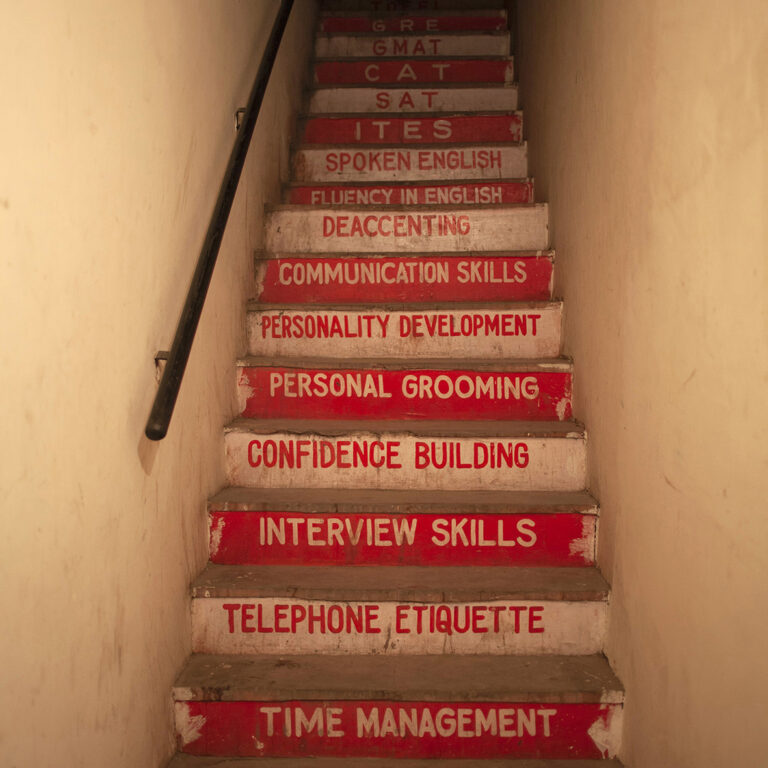
L’ingresso di una scuola di inglese a Chandigarh
© Rocco Rorandelli immagine e testo
“My India/Glory” rappresenta la V edizione delle mostre fotografiche diffuse nel centro storico di Triggiano, promosse dalla Fondazione Pasquale Battista con la direzione artistica di Annalisa Zito e la curatela di Manuela De Leonardis. Un progetto che dal 2022 trasforma vicoli, piazze e architetture del borgo antico in un museo a cielo aperto. Dopo “Memoria senza indulgenza” di Tony Gentile (2022), “Nûr/Luce” di Maïmouna Guerresi (2023), “Per tutta la vita | Para toda la vida” di Silvia Levenson (2024) e “La litania del cromo | Litania e kromit” di Elton Gllava (2025), la rassegna prosegue il proprio percorso portando per la prima volta lo sguardo dell’obiettivo fotografico oltre i confini europei, fino al cuore dell’Asia meridionale.
Il progetto rinnova così la vocazione della Fondazione a fare della fotografia uno strumento di racconto civile e di dialogo tra culture e territori distanti, restituendo alla comunità di Triggiano la possibilità di incontrare il mondo passeggiando tra le proprie strade.
Il progetto
“My India/Glory” raccoglie oltre quindici anni di lavoro di Rocco Rorandelli nelle grandi metropoli indiane – New Delhi, Mumbai, Chandigarh – attraversate da uno dei più grandi movimenti migratori della storia contemporanea: 250 milioni di persone in marcia dalle campagne verso le città. Non è un reportage nel senso tradizionale del termine, ma un diario visivo costruito per stratificazioni successive, anno dopo anno, sulla stessa terra che cambia.
“Glory” non è qui sinonimo di trionfo, ma di tensione. È la luce che si accende sopra i grattacieli appena finiti e, insieme, l’ombra dello smog che la trattiene; è la promessa di ascesa di un paese che si specchia nelle proprie torri di vetro e cemento, e il prezzo che milioni di vite pagano, silenziosamente, per quella ascesa. Una gloria ancora in costruzione, fotografata nel momento esatto in cui si gioca.
La poetica delle megalopoli
Da oltre quindici anni l’obiettivo di Rorandelli torna nelle stesse città indiane per misurarne, di anno in anno, l’avanzata: torri residenziali che si spingono fino al margine del disboscamento, una foschia di smog e polveri sottili così densa da filtrare la luce del sole, vegetazione monumentale che resiste a fatica nelle brecce del cemento che la imprigiona. È una fotografia che non rincorre l’istante ma la durata – il tempo lungo necessario a un paese per cambiare pelle, e il tempo lungo necessario a chi lo osserva per imparare a vederlo accadere, in controtendenza rispetto all’urgenza e all’istantaneità che oggi dominano l’immagine fotografica.
Formatosi come naturalista prima che come fotografo, Rorandelli guarda alla città quasi come a un organismo vivente, capace di espandersi, respirare, nutrirsi del territorio che la circonda. È uno sguardo dichiaratamente ambivalente: la preoccupazione per una cementificazione che avanza senza controllo convive con la consapevolezza che si tratti, in fondo, della stessa traiettoria che l’Italia ha attraversato al tramonto del proprio boom economico – la crescita di un paese che, prima o poi, troverà un nuovo equilibrio.
Ma l’espansione dei confini urbani non esaurisce il suo sguardo. Tra le architetture della crescita, l’obiettivo torna sempre alle persone: alle stratificazioni sociali e generazionali di un paese che è il secondo più popoloso del pianeta, con un’età media di appena ventinove anni e diseguaglianze economiche tanto profonde quanto in aumento. Sono frammenti che si insinuano tra le impalcature della metropoli – un mare di pendolari in una stazione ferroviaria, ragazzi che si allenano al cricket sognando un futuro altrove, un venditore di gelati che resiste come un’isola di lentezza nel cuore della città. Da un lato l’immagine di una megalopoli quasi mostruosa, che inghiotte tutto ciò che incontra; dall’altro un progetto di vita urbana ancora aperto, fatto di promesse, vittorie e fallimenti. È in questa soglia, tra meraviglia e inquietudine, che prende forma la “gloria” del titolo.
“My India/Glory” marks the fifth edition of the series of photography exhibitions in the historic centre of Triggiano, organised by the Pasquale Battista Foundation under the artistic direction of Annalisa Zito and curated by Manuela De Leonardis. A project which, since 2022, has been transforming the narrow streets, squares and architecture of the old town into an open-air museum. Following ‘Memoria senza indulgenza’ by Tony Gentile (2022), ‘Nûr/Luce’ by Maïmouna Guerresi (2023), “Per tutta la vita | Para toda la vida” by Silvia Levenson (2024) and “La litania del cromo | Litania e kromit” by Elton Gllava (2025), the exhibition series continues its journey, taking the photographer’s lens beyond European borders for the first time, right to the heart of South Asia.
The project thus renews the Foundation’s commitment to using photography as a tool for civic storytelling and dialogue between distant cultures and territories, giving the community of Triggiano the chance to encounter the world simply by strolling through its own streets.
The project
“My India/Glory” brings together over fifteen years of work by Rocco Rorandelli in India’s major cities – New Delhi, Mumbai, Chandigarh – which have been shaped by one of the greatest migratory movements in contemporary history: 250 million people moving from the countryside to the cities. It is not a photo-essay in the traditional sense of the term, but a visual diary built up in successive layers, year after year, on the very land that is changing.
“Glory” is not synonymous here with triumph, but with tension. It is the light that illuminates the newly completed skyscrapers and, at the same time, the shadow of smog that holds it back; it is the promise of a nation’s rise, reflected in its own towers of glass and concrete, and the price that millions of lives pay, silently, for that rise. A glory still under construction, captured at the very moment it is unfolding.
The Poetics of Megacities
For over fifteen years, Rorandelli’s lens has returned to the same Indian cities to measure, year on year, their expansion: residential towers reaching right to the edge of deforested areas, a haze of smog and fine particulate matter so dense that it filters the sunlight, monumental vegetation struggling to survive in the gaps between the concrete that imprisons it. It is a form of photography that does not chase the fleeting moment but rather duration – the long time it takes for a country to shed its skin, and the long time it takes for the observer to learn to witness this transformation, bucking the trend of urgency and immediacy that dominate the photographic image today. Trained as a naturalist before becoming a photographer, Rorandelli views the city almost as a living organism, capable of expanding, breathing and drawing sustenance from the surrounding landscape. It is an avowedly ambivalent perspective: concern over unchecked urban sprawl coexists with the realisation that, ultimately, this is the same trajectory that Italy followed at the twilight of its economic boom – the growth of a country that, sooner or later, will find a new equilibrium.
But the expansion of urban boundaries does not exhaust his perspective. Amidst the architecture of growth, the focus always returns to the people: to the social and generational stratifications of a country that is the second most populous on the planet, with an average age of just twenty-nine and economic inequalities that are as deep as they are growing. These are fragments that weave their way through the scaffolding of the metropolis – a sea of commuters in a railway station, young people practising cricket whilst dreaming of a future elsewhere, an ice-cream vendor holding out like an island of tranquillity in the heart of the city. On the one hand, the image of an almost monstrous megalopolis, swallowing up everything in its path; on the other, an urban way of life still in the making, made up of promises, triumphs and failures. It is in this liminal space, between wonder and unease, that the ‘glory’ of the title takes shape.